


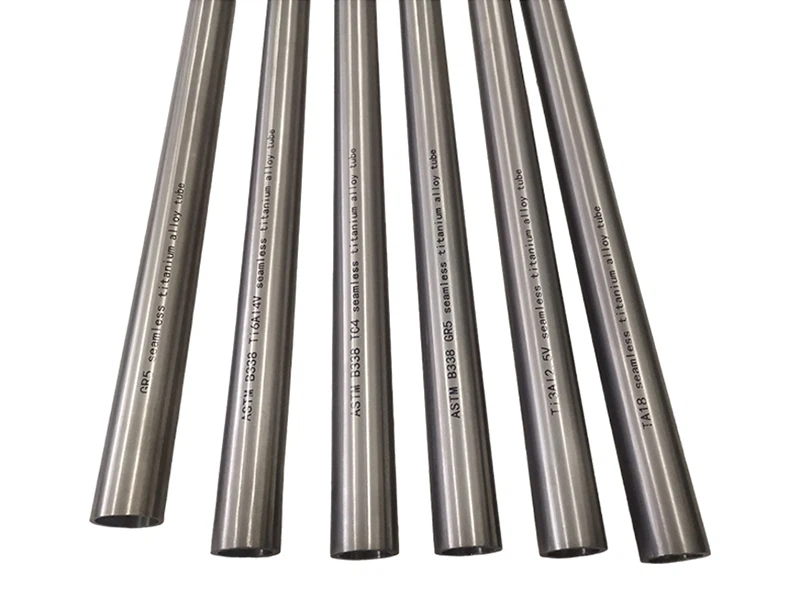
Jurui Metal Technology company is committed to the development and production of high-strength titanium alloy tubes in China. After 5 years of research and development, we have successfully overcome the difficulties of TC4(Gr5) Ti6Al4V titanium alloy tube processing, as one of the few manufacturers in the world, it has become one of the leading suppliers of TC4(Gr5) Ti6Al4V titanium alloy tubes in China and one of the top manufacturers of titanium alloy tubes.

Why choose us
Product Grades
We offer several grades of titanium alloy tubes, including TC4 (GR5 TI6Al4V), TA18 (Gr9), TA16 (Ti2.5Al2Zr), and TC11 (Ti6.5Al1.5Zr).
Production Equipment
Our production facility is equipped with an extruder, pipe rolling machine, annealing furnace, straightening machine, tube shrinking machine, drawing machine, and eddy current testing equipment.
Production Market
We serve markets in Australia, Russia, the USA, Germany, Japan, and South Korea.
Good Service
We provide high-quality after-sales service, including usage tracking and encouraging positive feedback. Our team responds rapidly within 24 hours.
Our Company
Jurui Metal Technology Co., Ltd. is located in Jiangyin, a water town in the south of the Yangtze River. As a global supplier of polyurethane wheels, polyurethane rollers, and other polyurethane products, Jurui Metal Technology is committed to creating added value for customers worldwide.
What is 6061 Aluminum Pipe?
6061 aluminum pipe is a magnesium and silicon alloyed aluminum material. This good all-purpose alloy has good corrosion resistance and formability and has medium strength. It has good machining characteristics and has excellent appearance after anodizing.

6061 T6 Tube is a high-quality aluminum alloy tube that is extensively used in various industrial applications. This tube is manufactured from 6061 aluminum alloy which is an excellent material for manufacturing high-quality and durable products.

Aluminum alloys have become essential in various manufacturing processes due to their lightweight, corrosion resistance, and strength. One of the popular aluminum alloys is the 2xxx series, which has copper as its primary alloying element.

Welcome to our company, a leading manufacturer of Aluminum Alloys 5xxx Tube in China, with over 10 years of experience in producing and exporting high-quality products to merchants worldwide.

Aluminum Alloys 6xxx Tube is an essential product for various industries globally. The product has been widely used across several production industries due to its durability, high strength, and lightweight.

Aluminum Alloys 7xxx Tube is an essential product in various industries, including aerospace, automotive, and military sectors. The product is made using aluminum alloy 7xxx that consists of zinc as the primary alloying element.

As a leading manufacturer of high-quality aluminum alloy tubes in China, we are pleased to introduce our product to international merchants. Aluminum alloy tubes are widely used in various sectors, including building construction, automotive, aerospace, and marine industries.
We believe that an excellent team is the core driver of the aggregation and amplification effect of the enterprise, and it is the solid support for the company to become stronger, better and bigger.

One of the key features of the 7075 Aluminum Tube is its high strength-to-weight ratio. This tube is made from 7075 aluminum alloy, which is known for its exceptional strength and durability.

Our 6061 T6 Aluminum Tube is made from 6061 aerospace grade aluminum alloy, which is highly durable and resistant to wear, corrosion, and heat.
Advantages of 6061 Aluminum Pipe
Exceptional Strength and Durability
The 6061 aluminum pipe is known for its strength, comparable to many steels. With a yield strength of 40,000 psi and a tensile strength of 45,000 psi, it proves suitable for structural applications in the aerospace industry.
Corrosion Resistance
Corrosion can be a formidable opponent in aerospace environments. 6061 aluminum pipe excels in this regard, developing a protective oxide layer on its surface that ensures long-term service even in marine or harsh outdoor settings.
Machinability
6061 aluminum pipes offer the significant advantage of easy machining, which allows for smoother drilling, cutting, and forming into various shapes. This property is especially beneficial for manufacturers in the automotive, aerospace, and consumer electronics sectors.
Weldability
6061 aluminum pipes itself well to various welding methods, including MIG and TIG welding. Proper filler material selection and preparation are vital for successful welds, and post-weld heat treatment can restore the strength of the material.
Heat Treatment
The T6 tempering process which involves solution heat treatment, aging, and quenching significantly increases the hardness, strength, hardness, and deformation resistance of the alloy. This makes 6061 aluminum pipe a strong choice for aerospace applications.
Formability
6061 aluminum pipe is easily formed, drilled, and bent, allowing for the production of various spacecraft structures and shapes.
Joining Capabilities
This alloy is easily joined utilizing various welding methods, enhancing the sealing performance of aerospace spacecraft.
Reduced Weight
With lower density compared to many other metals, 6061 aluminum pipe contributes to reducing the weight of spacecraft, a critical factor in aerospace design.
Application of 6061 Aluminum Pipe
Aerospace
6061 aluminum pipe is widely used in the field of aerospace, such as the manufacture of aircraft main structure, engine components and wings.
Automotive Industry
Due to its light weight and high strength properties, 6061 aluminum pipe is also widely used in the automotive industry. For example, there are good results in the manufacture of body and engine components.
Rail Transit
6061 aluminum pipe material is often used in railway vehicles and subway vehicles because it helps to reduce the weight of the train and increase the speed and efficiency of the vehicle.
Shipbuilding industry
6061 aluminum pipe is also frequently used in the shipbuilding industry. It has good corrosion and tarnishing properties, which makes it an ideal material in shipbuilding.
Electronic products
Due to the excellent electrical conductivity of 6061 aluminum pipe, it has also been widely used in the manufacture of electronic products. For example, it is commonly used to make enclosures for cases, heat sinks, and other electronic equipment.

History of 6061 Aluminum Pipe

6061 aluminum pipe is a versatile material that can be used in a variety of applications due to its unique composition. This alloy is mainly composed of aluminum, with magnesium and silicon being the main minor elements. The percentages of these elements vary according to the manufacturer's specifications, but are typically 0.6-1.2% magnesium and 0.4-0.8% silicon.
The addition of magnesium gives the alloy increased strength and stiffness while maintaining its lightweight properties, making it ideal for structural applications such as the aerospace or automotive industries, where weight reduction is critical while Without sacrificing durability.
Silicon helps improve the castability of this material by reducing shrinkage during solidification, which makes the manufacturing process easier, while also improving corrosion resistance.
Other trace elements can be added to further enhance specific properties, such as copper for increased electrical conductivity or zinc for improved machinability.
The composition of 6061 aluminum pipe has a wide range of potential uses in several industries due to its strength-to-weight ratio and excellent corrosion resistance.
Let's take a look at what the 7075 aluminum alloy means. The 7075 series has zinc as the primary alloy metal at 5.6%, with a 90% aluminum content. The remaining alloy metals include 2.5% magnesium, 0.23% chromium, and 1.6% copper. This mix provides significantly higher strength, but at a cost to the other aspects of the metal, especially in terms of corrosion resistance.
It's difficult to say which type of aluminum is better, because it will depend on your specific application. Generally speaking, 7075 aluminum has a larger amount of copper, which lowers its corrosion resistance compared to 6061 aluminum alloy. However, this flaw also makes it much stronger, reaching a yield strength nearly double that of 6061 at 503 MPa and a hardness of 150 compared to 6061's 95 on the Brinell scale. However, with this strength comes lower machinability, making 7075 aluminum alloy more difficult to work than the easy-working 6061 aluminum alloy, though both can be machined without too much difficulty. Both alloys are able to withstand being easily deformed while retaining the flexibility needed for resistance to shattering or cracking.
What Does the 6061 Mean in Aluminum Pipe?
As with many standards, the numbers used in the 6061 aluminum pipe have particular meanings. The 6061 series of aluminum pipe is represented by alloys containing silicon and magnesium, which provide a range of properties to the alloy to make it more workable, stronger or otherwise improve the blend. The 6061 aluminum pipe is a high-aluminum pipe, which makes it more workable and places it in the wrought classification. The last two digits in the series stand for the percentage of major alloy materials, representing 0.6% silicon and 1.0% magnesium. The 6061 aluminum pipe can also contain 0.2% chromium and 0.28% copper as a nominal mix. This leaves 97.9% aluminum pipe in the formulation, providing a high level of strength.
Is 6061 Aluminum Pipe Stronger Than Steel?
Depending on the temper of the aluminum, it can be stronger than stainless steel. Specifically, the yield strength of T6 temper 6061 aluminum pipe is stronger than stainless steel of a similar thickness, due to the specific properties of the alloy and the temper. Combined with the light weight of 6061 aluminum pipe, it has become a popular option for vehicle frames to improve strength while reducing weight, as well as its many uses in marine craft, aircraft, and a range of similar applications. That being said, many aerospace firms for commercial and military applications have moved to different alloys for specific reasons, due to the particular qualities of those alloys and increased specialization of the builds that are being created for a range of applications.

Different Tempers of 6061 Aluminum Pipe
6061 aluminum pipe is available in two tempers. Aluminum 6061 T4 and 6061 T6. The difference between the two is that T4 is naturally aged and T6 is artificially aged by heating it between 350 to 500°F for 12 to 24 hours. This gives the two different tempers distinctly different properties, and a comparative list of these physical properties can be seen below.
|
Property |
T4 Aluminum 6061 |
T6 Aluminum 6061 |
|
Tensile Strength |
35,000 psi |
45,000 psi |
|
Yield Strength |
21,000 psi |
40,000 psi |
|
Modulus of Elasticity |
10,000 ksi |
|
|
Thermal Conductivity |
1070 BTU-in/hr-ft2-F° |
1160 BTU-in/hr-ft2-F° |
|
Thermal Expansion Coefficient |
13.1 in/in-°F |
|
All things considered it can be a little difficult to see why aluminum 6061 T4 is even needed. T4 has an advantage when it comes to cold forming the metal bending tube or sheet without the use of heat. This type of cold forming is somewhat limited for 6061 T6 due to the temper's higher strength making it more difficult to get a satisfactory result without damaging the metal.
However, of the two different tempers 6061 T6 is the more widely used. The results of its heat treatment is an aluminum that has the highest practical strength for most purposes. If heated to higher temperatures or for longer periods of time it would gain greater dimensional stability, but this would come at the cost of strength and hardness.
As it is, 6061 aluminum pipe's properties, specifically its high tensile and yield strengths have widespread applicability to a range of roles. This is enhanced by the fact that it is among the most workable of the different aluminum alloys with excellent response to machining, welding and brazing, and even bending sheets and tubes as needed. This combination of high strength and good workability has seen aluminum alloys used in a dizzying array of applications.
What Is the Operating Temperature Range for 6061 Aluminum Pipe?
The operating temperature range can be described in terms of the hot working, annealing, and aging temperature range. 6061 aluminum pipe is hot worked at a temperature range of 260–372 °C. Annealing can be conducted at a temperature of 413 °C for a period of 2–3 hrs. Afterward, the metal is cooled at a controlled temperature of 10 °C per hr until 260 °C is reached. Another operating temperature is the aging temperature. Aging of 6061 aluminum pipe can be conducted at a temperature of 160 °C for a period of 8 hrs before it is cooled in the air.
Physical Properties of 6061 Aluminum Pipe
Type 6061 aluminum pipe is of the 6xxx aluminum alloys, which entails those mixtures which use magnesium and silicon as the primary alloying elements. The second digit indicates the degree of impurity control for the base aluminum. When this second digit is a "0", it indicates that the bulk of the alloy is commercial aluminum containing its existing impurity levels, and no special care is needed to tighten controls. The third and fourth digits are simply designators for individual alloys (note that this is not the case with 1xxx aluminum alloys). The nominal composition of type 6061 aluminum pipe is 97.9% Al, 0.6% Si, 1.0%Mg, 0.2%Cr, and 0.28% Cu. The density of 6061 aluminum pipe alloy is 2.7 g/cm3 (0.0975 lb/in3). 6061 aluminum pipe alloy is heat treatable, easily formed, weld-able, and is good at resisting corrosion.
Mechanical Properties of 6061 Aluminum Pipe
The mechanical properties of 6061 aluminum pipe differ based on how it is heat treated, or made stronger using the tempering process. To simplify this article, the strength values for this alloy will be taken from T6 tempered 6061 aluminum pipe (6061-T6), which is a common temper for aluminum plate and bar stock. Its modulus of elasticity is 68.9 GPa (10,000 ksi) and its shear modulus is 26 GPa (3770 ksi). These values measure the alloy's stiffness, or resistance to deformation, and are found in Table 1. Generally, this alloy is easy to join via welding and readily deforms into most desired shapes, making it a versatile manufacturing material.
Two important factors when considering mechanical properties are yield strength and ultimate strength. The yield strength describes the maximum amount of stress needed to elastically deform the part in a given loading arrangement (tension, compression, twisting, etc.). The ultimate strength, on the other hand, describes the maximum amount of stress a material can withstand before fracturing (undergoing plastic, or permanent deformation). For static applications, the yield strength is the more important design constraint as per industry standard design practices; however, the ultimate strength can be useful for certain applications that call for it. 6061 aluminum pipe has a yield tensile strength of 276 MPa (40000 psi), and an ultimate tensile strength of 310 MPa (45000 psi).
Shear strength is the ability of a material to resist being sheared by opposing forces along a plane, just as a scissor cuts through paper. As the two scissor blades close, their opposing forces act on the cross sectional plane of the paper and cause it to fail "in shear". This value is useful in torsional applications (shafts, bars etc.), where twisting can cause this kind of shearing stress on a material. The shear strength of 6061 aluminum pipe is 207 MPa (30000 psi).
Fatigue strength is the ability of a material to resist breaking under cyclical loading, where a small load is repeatedly imparted on the material over time. This value is useful for applications where a part is subject to repetitive loading cycles such as vehicle axles or pistons. The fatigue strength of 6061 aluminum pipe is 96.5 Mpa (14000 psi), which is calculated using 500,000,000 cycles of continuous, cyclical loading below the yield point.
Our Certifications
GJB9001C-2017


Ultimate FAQ Guide to 6061 Aluminum Pipe
Hot Tags: 6061 aluminum pipe, China 6061 aluminum pipe manufacturers, welded alloy aluminum tube, aluminum alloy tube for automotive, aluminum alloy tube for machinery, aluminum alloy round tube, aluminum alloy tube for framework, aluminum alloy tube with various lengths