


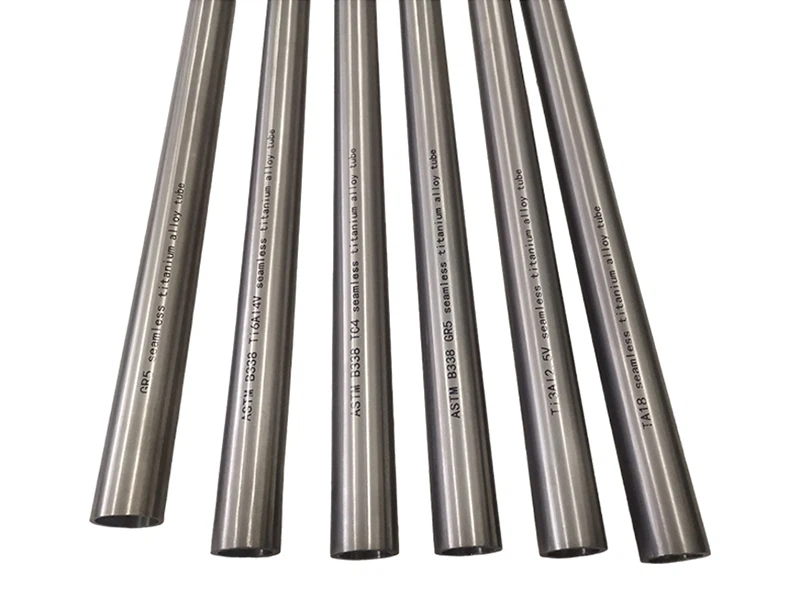
Jurui Metal Technology company is committed to the development and production of high-strength titanium alloy tubes in China. After 5 years of research and development, we have successfully overcome the difficulties of TC4(Gr5) Ti6Al4V titanium alloy tube processing, as one of the few manufacturers in the world, it has become one of the leading suppliers of TC4(Gr5) Ti6Al4V titanium alloy tubes in China and one of the top manufacturers of titanium alloy tubes.

Why choose us
Product Grades
We offer several grades of titanium alloy tubes, including TC4 (GR5 TI6Al4V), TA18 (Gr9), TA16 (Ti2.5Al2Zr), and TC11 (Ti6.5Al1.5Zr).
Production Equipment
Our production facility is equipped with an extruder, pipe rolling machine, annealing furnace, straightening machine, tube shrinking machine, drawing machine, and eddy current testing equipment.
Production Market
We serve markets in Australia, Russia, the USA, Germany, Japan, and South Korea.
Good Service
We provide high-quality after-sales service, including usage tracking and encouraging positive feedback. Our team responds rapidly within 24 hours.
Our Company
Jurui Metal Technology Co., Ltd. is located in Jiangyin, a water town in the south of the Yangtze River. As a global supplier of polyurethane wheels, polyurethane rollers, and other polyurethane products, Jurui Metal Technology is committed to creating added value for customers worldwide.
What is 6061 Aluminum Tubing?
6061 aluminum tubing is an excellent candidate for most processing techniques with good corrosion resistance. A lightweight material with a smooth surface, it is heat treatable, non-magnetic, and resistant to stress cracking. This is an extruded tube meaning there is no seam. It's great for structural projects that require light weight material including railings, hinges, bushings, and ornamental purposes.

6061 T6 Tube is a high-quality aluminum alloy tube that is extensively used in various industrial applications. This tube is manufactured from 6061 aluminum alloy which is an excellent material for manufacturing high-quality and durable products.

Aluminum alloys have become essential in various manufacturing processes due to their lightweight, corrosion resistance, and strength. One of the popular aluminum alloys is the 2xxx series, which has copper as its primary alloying element.

Welcome to our company, a leading manufacturer of Aluminum Alloys 5xxx Tube in China, with over 10 years of experience in producing and exporting high-quality products to merchants worldwide.

Aluminum Alloys 6xxx Tube is an essential product for various industries globally. The product has been widely used across several production industries due to its durability, high strength, and lightweight.

Aluminum Alloys 7xxx Tube is an essential product in various industries, including aerospace, automotive, and military sectors. The product is made using aluminum alloy 7xxx that consists of zinc as the primary alloying element.

As a leading manufacturer of high-quality aluminum alloy tubes in China, we are pleased to introduce our product to international merchants. Aluminum alloy tubes are widely used in various sectors, including building construction, automotive, aerospace, and marine industries.
We believe that an excellent team is the core driver of the aggregation and amplification effect of the enterprise, and it is the solid support for the company to become stronger, better and bigger.

One of the key features of the 7075 Aluminum Tube is its high strength-to-weight ratio. This tube is made from 7075 aluminum alloy, which is known for its exceptional strength and durability.

Our 6061 T6 Aluminum Tube is made from 6061 aerospace grade aluminum alloy, which is highly durable and resistant to wear, corrosion, and heat.
Advantages of 6061 Aluminum Tubing
High Resistance to Corrosion
The combination of silicon and magnesium makes it more resistant than most others in its family of aluminum alloys. Because of this, you can use it inside or outside without having to worry about significant rust forming on your equipment – even if weather conditions aren't ideal. In fact, it is one of the best materials available for water cooling and underwater welding. If your product is frequently exposed to moisture, humidity, or saltwater, 6061 aluminum tubing is an excellent choice because it won't corrode any quicker than other types of aluminum.
Strength
This is partly owed to the addition of silicon to the mix, which increases its ability to resist corrosion and increases strength. Additionally, it has excellent cold work properties, which means that it can be bent and molded without cracking or breaking. For example, if you need a certain curve in your product, 6061 aluminum tubing is ideal because you can bend it into shape easily instead of cutting panels out then weld them together with high-strength joints. In fact, this type of metal is often used for bridges and buildings because they want something that will hold up over time while remaining cost-effective for consumers.
Marine Applications
Because of its corrosion resistance, this alloy is a popular choice for boat building and other marine applications. If your boat or ship will be exposed to salt water, the 6061 aluminum tubing alloy makes an excellent material to use because it won't rust as quickly as you would expect; some people have even used it in their underwater cars. It's also worth noting that it can withstand marine environments with ease while remaining strong enough to handle the stress placed on it.
Most Affordable Variety of Aluminum
Because 6061 aluminum tubing is used so often, and the machines that make pieces out of them are incredibly efficient, this alloy is very cost-effective when compared to other materials.
Application of 6061 Aluminum Tubing
Aerospace Industry
6061 aluminum tubing are extensively used in the aerospace industry due to their excellent strength-to-weight ratio, corrosion resistance, and weldability. These plates are used in the construction of airplane wings, fuselage, and other critical components.
Automotive Industry
The automotive industry also majorly depends on 6061 aluminum tubing for various applications. These plates are used to manufacture various parts, including wheels, engine blocks, and transmission cases. Their lightweight and high-strength properties make them an ideal choice for the automotive industry, where reducing the vehicle's weight is critical to improving fuel efficiency.
Construction Industry
6061 aluminum tubing are widely used in the construction industry due to their excellent strength, durability, and resistance to corrosion. These plates are used to manufacture building facades, roofing, and structural components. Due to the lightweight and unmatched strength properties of 6061 aluminum tubing, they are usually an ideal choice for constructing large structures such as bridges and high-rise buildings.
Marine Industry
The marine industry also extensively uses 6061 aluminum tubing due to their excellent corrosion resistance and strength-to-weight ratio. These plates are used to manufacture various marine components such as boat hulls, masts, and decks. In addition, the corrosion-resistant properties of 6061 aluminum tubing make them suitable for use in marine environments where saltwater corrosion can be a significant problem.
Medical Industry
The medical industry also uses 6061 aluminum tubing due to their excellent biocompatibility and strength. These plates are used to manufacture various medical devices, including surgical instruments and implants. The biocompatible properties of 6061 aluminum tubing make them good for use in the medical industry, where compatibility with the human body is crucial.
6061 Aluminum Tubing Properties

6061 Corrosion and Cracking
6061 aluminum tubing was the first alloy to demonstrate acceptable levels of resistance to stress and corrosion. The grade primarily contains Magnesium and Silicon elements. Other elements in descending order include iron, copper, zinc, manganese, and titanium. The 6061 alloy contains copper, unlike other grades such as the 5052. That makes it more resistant to corrosion than other alloys. It has excellent corrosion-resistance performance against ammonia hydroxide and nitric acid.

Strength and Structural Applications
The 6061 aluminum tubing is a medium-to-high strength alloy with many structural applications. The alloy has 0.2% Chromium, which gives it additional strength characteristics. It has a tensile strength between 20 and 42 KSI. The alloy has excellent formability and weldability, which is why it is viable for a wide range of uses. It has enough strength and corrosion resistance for automotive, architectural, and structural applications. Manufacturers will often choose the grade for sheet metal assemblies, electronic parts, chemical tanks, among others.

Heat Treatment and Mechanical Properties
To improve the machining and mechanical properties of the alloy, aluminum alloys have to be heat treated. The 6061 aluminum tubing tubing can respond to heat treatment. It is used for making automotive parts and construction materials. The 6061 grade is treated in a solution and then aged to enhance its properties. 6061-T6 aluminum is aged artificially; then, it is heat-treated to maximize its strength.
Differences in Characteristics
Strength: In the "T6 condition" (both metals heat-treated with a solution and aged), aluminium 7075 T6 has a tensile strength nearly double that of 6061 T6 aluminium. 7075 alloy also has a higher shear strength which is about 1.5 times that of 6061 alloys in the same T6 condition. Overall, 7075 T6 is also harder than 6061 T6 alloys.
Machinability: Machinability is a property that shows the measure of how a material reacts to machining processes like cutting, drilling, milling and die-casting, among others. Both 7075 and 6061 aluminium alloys have good machinability. But 6061 is the more preferred choice for applications where machining is necessary. However, 7075 aluminium alloy is also rated to have fair machinability.
Differences in Characteristics
Formability and welding: 6061 aluminium alloy has good formability and welding because it has silicon and magnesium as its principal alloying elements. 7075 is a harder material because of the higher zinc content. It is not conducive to forming or welding unless it is in the annealed condition where it can be formed and heat-treated if necessary and welded.
Corrosion resistance: Both alloys have excellent corrosion resistance properties because aluminium forms a layer of oxide when exposed to air or water. This oxide layer renders the alloy non-reactive to the elements that are corrosive to the metal underneath. However, 6061 alloy has copper as an alloying element, making it slightly less corrosion resistant than other alloys, including 7075 alloys. However, corrosion resistance can be enhanced by coating 6061 aluminium alloy with a protective layer.
Differences in Characteristics
Anodising: Anodising is converting the metal surface into a decorative and durable anodic oxide finish using an electrochemical process. 6061 and other alloys in the 6XXX series have excellent anodising qualities. The oxide layer that forms after the anodising process is transparent and offers protection to the surface.
Density
Aluminium has the same density. But because these are alloys made by adding other metals with different densities, the density of the alloy will change. Density is one of the most essential characteristics to consider when comparing the physical properties of metals.
7075 aluminium has a density of 2.81g/cm3, which is higher than that of pure aluminium. The alloy can also be strengthened using heat treatment processes, with the most common temper being 7075-T6.
6061 aluminium has a density of 2.7 g/cm3. It is about the same as pure aluminium metal, largely because of the high amount of aluminium the alloy contains.
What Is the Alloy Composition of 6061 Aluminum Tubing?
The alloy composition of 6061 aluminum tubing is aluminum (97.9 %), magnesium (1.0 %), silicon (0.6 %), copper (0.28 %), chromium (0.2 %), and a trace amount of other elements. A variety of aluminum alloys are available. Each of them is specified by a code number, such as the 6000 series, 7000 series, and 1000 series. Moreover, each digit of the number is representative of certain attributes that uniquely identify the aluminum alloys. In the case of 6061 aluminum tubing, which is part of the 6000 series, the initial number 6 indicates that the primary alloying elements are magnesium and silicon. These elements are present in greater quantities than the other alloying elements. The second digit emphasizes impurity control and that due attention should be given as the alloying elements are combined with the base aluminum element. Therefore, the number 0 in 6061 indicates that no special care is required to tighten controls. The third and fourth digits only identify the alloys within their series, without any particular meaning. However, this is not the case with the 1000 series, in which the last two digits represent the minimum additional purity above 99 %. For example, 1000 and 1050 indicate that the alloy would have 99 % and 99.5 % minimum aluminum, respectively.


6061 aluminum tubing strength depends on the tempered grade, including 6061-O, 6061-T4, and 6061-T6. With 6061-T6, for example, the parameters for measuring how strong it is depends on the yield and tensile strengths. The yield strength of a material measures its allowable stress limit when force is applied to it. When the force exerted is above this value, permanent deformation will take place and the material is unable to return to its original shape. On the other hand, the tensile stress of a material is the maximum stress above which it will fail and break. That said, the yield stress of 6061-T6 aluminum is at least 35,000 psi or 241 Mpa. While its tensile stress is a value upwards of 42000 psi or 290 Mpa.
1. It forms a thin, protective oxide layer when exposed to air to help prevent corrosion, making it an excellent choice for demanding applications.
2. One of the most weldable aluminum alloys available, it can be welded using a variety of methods, including TIG, MIG, and arc welding.
3. 6061 aluminum tubing is among the most recycled materials in the world, capable of being recycled repeatedly without losing any of its quality.
4. Its elemental composition is aluminum (97.9%), magnesium (1.0 %), silicon (0.6 %), copper (0.28 %), chromium (0.2 %), and trace amounts of other elements (0.15% each).
5. Corrosion resistance and strength can be improved through tempering just below the melting point, which enhances the characteristics of metal by subjecting it to a high temperature.
6. Its shear strength, which is a material's ability to resist being sheared by opposing forces along a plane, is about 207 MPa (30,000 psi).
7. The most common temper for 6061 aluminum tubing is T6, a heat-treated temper with good strength, hardness, and durability.
8. It can be hot worked at a temperature of 260 to 372°C (500 to 700°F)-a temperature range above aluminum's recrystallization temperature, enabling the alloy to be deformed without cracking.
9. Fatigue strength is 96.5 MPa (14,000 psi), so it can withstand a repeated stress level of 96.5 MPa for a large number of cycles before it fails.
10. It is especially good at resisting corrosion from concentrated nitric acid, ammonia, and ammonium hydroxide. You can remove the corrosive effects by coating the alloy with a protective layer, to which 6061 alloy responds well.
6061 Aluminum Tubing Production Process
Raw Material Selection
The process begins with the careful selection of high-quality aluminium lloys. The choice of alloy depends on the specific requirements of the final product. Common alloys include 6061, known for their excellent strength-to-weight ratio and corrosion resistance.
Billeting
The selected 6061 aluminum alloy is then heated and cast into cylindrical billets. These billets serve as the starting point for the tube manufacturing process. Temperature control during this stage is critical to ensuring uniformity and eliminating any potential defects in the material.
Extrusion
The extrusion process is a key step in transforming the billet into a seamless tube. The heated billet is pushed through a precision-designed die, creating a tube with the desired outer diameter and thickness. This process is highly efficient and allows for the production of long lengths of seamless tubing.
Heat Treatment
To enhance the mechanical properties of the tube, it undergoes a heat treatment process. This involves controlled heating and cooling to optimise the material's strength, hardness, and durability. Heat treatment also contributes to stress relief, minimising any internal stresses introduced during extrusion.
Cold Drawing
Following heat treatment, the tube is subjected to cold drawing. This process involves reducing the tube's diameter and wall thickness while increasing its length. Cold drawing imparts dimensional precision and improves the surface finish of the tube. It also enhances the tube's mechanical properties and tightens its tolerances.
Cutting and straightening
The drawn tube is then cut into specific lengths, and any distortions or deformities are corrected through a straightening process. Precision cutting ensures that the tubes meet the required specifications and standards.
Surface Finishing
6061 aluminum alloys typically undergo surface finishing processes to enhance their appearance and protect against corrosion. Common surface treatments include anodizing, powder coating, or polishing, depending on the intended application.
Quality Control
Throughout the manufacturing process, rigorous quality control measures are implemented to ensure that the seamless 6061 aluminum alloy meet industry standards. This includes dimensional checks, non-destructive testing, and inspection for any surface defects.
Our Certifications
GJB9001C-2017


Ultimate FAQ Guide to 6061 Aluminum Tubing
Hot Tags: 6061 aluminum tubing, China 6061 aluminum tubing manufacturers, aluminum alloy cylindrical tube, alloy aluminum tube, aluminum alloy tube for automobile, alloy aluminum seamless tube, aluminum piping, aluminum alloy tube for storage equipment