

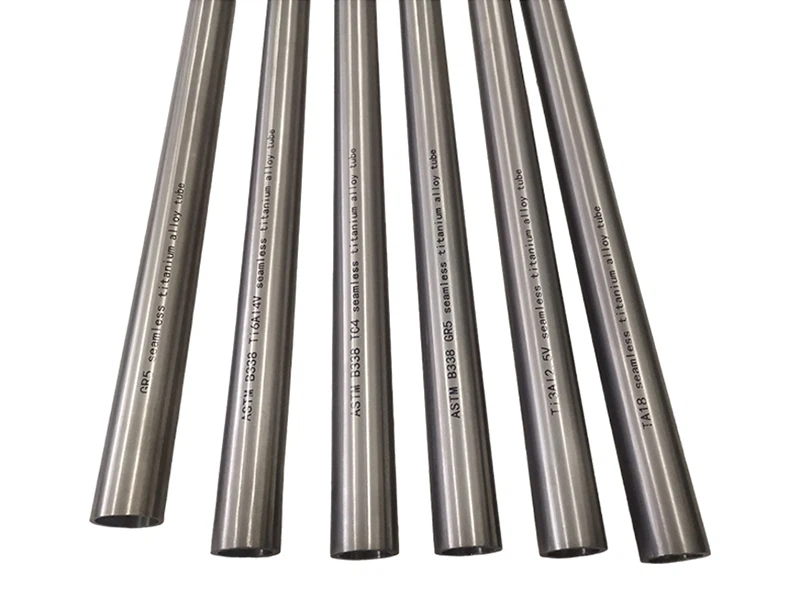
Jurui Metal Technology company is committed to the development and production of high-strength titanium alloy tubes in China. After 5 years of research and development, we have successfully overcome the difficulties of TC4(Gr5) Ti6Al4V titanium alloy tube processing, as one of the few manufacturers in the world, it has become one of the leading suppliers of TC4(Gr5) Ti6Al4V titanium alloy tubes in China and one of the top manufacturers of titanium alloy tubes.

Why choose us
Product Grades
We offer several grades of titanium alloy tubes, including TC4 (GR5 TI6Al4V), TA18 (Gr9), TA16 (Ti2.5Al2Zr), and TC11 (Ti6.5Al1.5Zr).
Production Equipment
Our production facility is equipped with an extruder, pipe rolling machine, annealing furnace, straightening machine, tube shrinking machine, drawing machine, and eddy current testing equipment.
Production Market
We serve markets in Australia, Russia, the USA, Germany, Japan, and South Korea.
Good Service
We provide high-quality after-sales service, including usage tracking and encouraging positive feedback. Our team responds rapidly within 24 hours.
Our Company
Jurui Metal Technology Co., Ltd. is located in Jiangyin, a water town in the south of the Yangtze River. As a global supplier of polyurethane wheels, polyurethane rollers, and other polyurethane products, Jurui Metal Technology is committed to creating added value for customers worldwide.


What is Aluminum Alloy Tube?
Aluminum alloy pipes refer to the extrusion of aluminium alloy into metal tubular materials, which can have one or more closed through holes with uniform wall thickness and cross section. They are used in automobile, ship, aerospace, airlines, household appliances, modern agriculture, electromechanical engineering, home decoration and other manufacturing industries.
Advantages of Aluminum Alloy Tube
Corrosion Resistant
Of all the advantages brought by aluminum, none are more important than corrosion resistance. This metal can fight rust far better than most of the popular metals, which is why it’s often selected for a variety of outdoor and aquatic applications.
Lightweight
While other metals may be stronger, aluminum has a clear advantage in overall weight. Steel, for example, weighs much more than aluminum. Iron is also much heavier; aluminum is roughly a third of the weight compared to iron. For this reason, aluminum tubing is ideal for applications in the transportation and aerospace industries. With aluminum tubing, engineers can create far lighter vehicles.
Sound Insulating
Sound control can be important for a variety of reasons, and while aluminum tubing may not be considered a sound-control material (like sound-insulating drywall, for example), it does have the ability to reduce sounds from one area to another.
Heat and Flame Resistant
Aluminum alloy tubes also have heat-insulation properties and can be used when even temperatures are required for an industrial or mechanical structure.
Long-term Durability
Aluminum is specifically manufactured to resist corrosion, which not only keeps it strong but also ensures long-term durability. Builders, manufacturers, and industrial experts who need metal tubing that will last for decades often turn to aluminum, assuming the greater strength of steel is not required.
Malleable
Aluminum is one of the most versatile metals currently available, which is why aluminum tubing is so popular. This metal can be formed into a variety of different shapes and sizes, and it’s generally easy (and relatively affordable) to work with. This makes aluminum the ideal choice for applications where malleability is important.
Recyclable
Many companies are adopting eco-friendly practices, which include the use of recyclable materials. Because aluminum tubing can be recycled, extra material, such as cut-off ends, can be recycled instead of going into the landfill.
Types of Aluminum Alloy Tube
Seamless Aluminum Tubes
Seamless aluminum tubes are a remarkable engineering feat, distinguished by their smooth, uninterrupted surface and exceptional structural integrity. These tubes are manufactured through a precise and intricate process known as extrusion and piercing.
Welded Aluminum Tubes
Welded aluminum tubes, in contrast to seamless tubes, are crafted by joining two or more aluminum sections through a welding process. This process involves heating the edges of the aluminum sections until they melt and fuse, creating a strong, continuous joint. The most common welding methods for aluminum tubes are TIG (Tungsten Inert Gas) and MIG (Metal Inert Gas) welding, both of which offer precise control over the welding process to ensure a secure connection.
Extruded Aluminum Tubes
Extruded aluminum tubes are crafted through a specialized manufacturing process known as extrusion. This process begins with a cylindrical billet of aluminum, typically a specific alloy chosen for its properties, such as 6061 or 6063. The billet is heated to a malleable state and then forced through a die, which imparts the desired shape to the aluminum as it emerges on the other side. Extrusion enables the creation of aluminum tubes with a wide range of shapes, sizes, and cross-sectional profiles, including circular, rectangular, and square.
Drawn Aluminum Tubes
Drawn aluminum tubes are created through a precision manufacturing process known as cold drawing. This method starts with a solid aluminum billet or a previously extruded tube. The billet or tube is cleaned and coated with a lubricant to reduce friction. It is then pulled through a series of dies with progressively smaller diameters. As the aluminum passes through these dies, it is cold-worked, reshaping at room temperature. This process continues until the tube reaches its desired dimensions and smoothness.
Structural Aluminum Tubes
Structural aluminum tubes are distinguished by their exceptional structural integrity and strength-to-weight ratio. These tubes are designed and manufactured to withstand heavy loads, making them a vital component in various industries and applications where structural stability is paramount. Their unique properties stem from using high-strength aluminum alloys, such as 6061 and 6063, combined with precise manufacturing processes.
Application of Aluminum Alloy Tube
In the aerospace sector, the lightweight nature of aluminum makes it indispensable for components like fuselages, wing structures, and engine parts. The material’s high strength-to-weight ratio contributes to the overall efficiency and safety of the aircraft. For instance, the Boeing 747 is primarily made of aluminum. This is akin to an athlete wearing lightweight but sturdy gear to optimize performance without compromising safety.
In automotive design and manufacturing, aluminum alloy tubes and pipes are used extensively to reduce vehicle weight, improving fuel efficiency and reducing emissions. They are found in frames, engine components, exhaust, and cooling systems. Think of using aluminum in cars, like opting for a light yet durable backpack for a long hike; it makes the journey easier without sacrificing essential functions.
In construction, aluminum alloy tubes are often used in scaffolding, framework, and railings. Pipes are commonly employed for plumbing and HVAC systems. The material’s corrosion resistance is especially beneficial in this context, as it ensures a longer lifespan for the structure. Imagine constructing a building using Lego bricks; if those bricks were made of aluminum, you’d have a robust, long-lasting structure that could withstand various environmental challenges.
Aluminum alloy tubes construct modern, lightweight furniture such as chairs, tables, and bed frames. The material’s malleability allows for intricate designs, making it a favorite for decorative pieces. Imagine aluminum furniture as the sleek, modern decor in a contemporary art gallery; it complements the space without overpowering it and offers functional benefits like ease of movement.
Aluminum alloy tubes are extensively used to construct railings and fences. Their corrosion resistance makes them particularly useful for outdoor installations exposed to the elements. For instance, aluminum railings along a staircase or balcony are functional and add an aesthetic touch. They serve a dual purpose, much like a well-designed garden fence that keeps out intruders while beautifying the property.
Aluminum is commonly used to fabricate various medical devices like wheelchairs, crutches, and surgical instruments. Its lightweight and corrosion-resistant properties make these devices both portable and long-lasting. In the medical world, aluminum devices can be equated to a Swiss Army knife: versatile, reliable, and exceptionally useful in multiple scenarios.
Alloys Used in Aluminum Alloy Tube
The most common aluminum alloys utilized for tube are 2024, 3003, 6061, 5052, and 7075. Their main alloying elements of magnesium, manganese, copper, zinc, and silicon lend each alloy marginally different mechanical and physical attributes.
A wide range of Aluminum tube sizes are available. Aluminum tubes are frequently chosen for their lightness in weight, thermal and electrical conductivity, and resistance to corrosion. For example, engineers specify alloys 7075, 6061, and 2024 for aircraft assemblies because they have high strength to weight ratio and decent fatigue resistance. Untreated 7075 and 2024 are susceptible to corrosion, and 6061 is naturally corrosion-resistant and simpler to weld. 7075 offers more strength with lesser weight, but is more costly.
Alloy 3003 is proper for applications that require resistance to corrosion and more strength, with less of an importance on ductility. For applications which depend on multiple joints, a highly weldable 5052 might be chosen.
The characteristics of a given aluminum alloy relies on its heat treatment history or temper. Temper O specifies the alloy is utilized as hardened, at its peak ductility and lowermost strength. Tempers starting with "T," such as T6, T4, and T3, involve heat treatment. Aging steps or cold working frequently follow to anneal the metal by hardening it on the particle or molecular level.
After choosing the right aluminum alloy and temper for an application, the next stages will be specifying its dimensions and any extra fabrication operations. Aluminum tubing ODs usually range between 0.062in and 3.00in, having wall thicknesses between 0.010 in. and 0.250 in. Aluminum tubing suppliers can shear, flare, bend, and fabricate tubing to customer’s requirements. After aluminum tubing has had a lengthy service life, it can be recycled since it’s manufactured from 99.8% pure aluminum alloy.
Properties of Aluminum Alloy Tubes
If you look at the properties of aluminum alloy tubes from a buyer’s perspective, there’s great news. Compared to steel, aluminum tubing can be acquired in large volumes when purchased per weight.
Aluminum tubings are widely used in manufacturing facilities, most likely because they do not tarnish for a long time. Additionally, painting them is an added layer of protection against contaminants, and aluminum alloy tubes can hold layers of paint well. Due to their strength and durability, aluminum pipes are used in various applications like hydraulic systems, fuel lines, etc.
Aluminum is excellent at conducting heat, which is why aluminum alloy tubes are preferred for applications involving fluctuating temperatures or where there’s a need for temperature control, such as HVAC systems and refrigeration units.
When manufactured using magnesium and silicon, aluminum can produce even stronger alloys, such as 6061 aluminum alloy tubes, resulting in a strong aluminum alloy with exceptional values like higher weldability and outstanding corrosion resistance.

Threaded Connections
Threaded connections are a common method of joining aluminum alloy tube sections together. To create a threaded connection, one end of the pipe is threaded while the other end has a coupling nut that screws onto it. The two ends are then connected by screwing the coupling nut onto the threaded section until it is secure. Threaded connections provide an effective seal and can be easily disassembled if needed.
Welding
Welding is another option for joining aluminum alloy tubes together. It’s best to use welding when connecting two pieces of pipe that are not easily accessible or when there’s no room for couplings or fittings. Welding creates a strong bond between two pieces of metal, making it ideal for applications where additional strength is needed. However, welding does require special equipment and knowledge, so it may not be suitable for all projects.
Compression Fittings
Compression fittings are another popular method for joining aluminum alloy tubes that don’t require welding or threading. Compression fittings consist of two parts; a fitting and a sleeve that holds the fitting in place against the pipe wall when tightened down with a wrench or spanner. Compression fittings provide an effective seal and can be removed relatively easily if needed in future repairs or alterations to your project’s piping system.
Step 1: Extrusion Die to the Extrusion Press
Before extruding, the die should be preheated to 450 or up to 500 degrees Celsius to help exploit its life and guarantee even metal flow. Once the die is preheated, it can be put in the extrusion press.
Step 2: Preheated Aluminum Billet Pre-Extrusion
Next, a cylindrical block of Aluminum alloy, named a billet, is cut from a long mass of alloy material. It is put in an oven and preheated to 400 or 500 degrees Celsius. It becomes malleable enough for the extrusion procedure, but not molten.
Step 3: Billet Moved to the Extrusion Press
As soon as the billet is done preheating, it is mechanically moved to the extrusion press. Before loading it onto the press, a lubrication or release agent is applied on it. The release agent is also applied on the extrusion ram, to avoid the ram and billet from sticking together.
Step 4: Pushing the Billet into the Container
The malleable billet is now loaded in the extrusion press, the hydraulic ram puts 15,000 tons of pressure on it. As the ram puts pressure, the billet solid is forced into the extrusion press’ container. The metal increases in size, filling the container walls.
Step 5: Extruded Solids
As the alloy solid fills the container, it is pressed up onto the extrusion die. With constant pressure, the aluminum solid is trapped and can only emerge through the die’s opening(s). It comes out of the die opening as a fully-formed pipe or tube.
Step 6: Running and Quenching Extrusions
After coming out, a puller grips the extrusion. It directs it across the run out table, matching the speed at which it exits from the press. As it travels across the run out table, the tube, or pipe is "quenched," or consistently cooled using a fan above the table or by water bath.
Step 7: Cut to Table Length Extrusions
Once the extrusion gets to its full table length, it is cut by a heated saw, separating it from the extrusion procedure. At every stage of the procedure, temperature plays a significant role. Although the extrusion is quenched after leaving the press, it is not yet completely cooled.
Step 8: Cooling Extrusions
After cutting, table length extrusion is mechanically moved from the run out to a cooling table. The pipes or tubes stay there until they get to room temperature. As soon as they do, they will have to be stretched.
Step 9: Stretcher Transfer and Stretched to Alignment
Some natural twisting occurs in the pipe or tubes that need to be fixed. To fix this, they are transferred to a stretcher. Each piping or tubing is gripped mechanically on both ends and stretched until it is straightened and brought to specification.
Step 10: Cutting to Length Extrusions
With the table length extrusion now straightened and completely work-hardened, they are moved to the saw table. Here, they are cut to pre-specified sizes, usually from 8 to 21 feet (6.4 m) long. At this point, the qualities of the extrusion matches the T4 temper. After cutting, they can be transferred to an oven for aging to be aged to the T6 or T5 temper.
Considerations When Choosing Aluminum Alloy Tubes

1. Application-specific Requirements
The selection of aluminum alloy tubes is intricately linked to the specific requirements of their intended use. Different applications necessitate varying characteristics, such as strength, corrosion resistance, thermal conductivity, and dimensional precision. For example, in the aerospace industry, where lightweight and high strength is paramount. Conversely, in architectural applications, extruded aluminum alloy tubes offer the versatility to create custom shapes and designs for building structures. Understanding the unique demands of the application is crucial to selecting the right type to ensure optimal performance and reliability.

2. Cost and Budget
The cost can vary significantly depending on the type, alloy, dimensions, and manufacturing processes involved. Seamless tubes, for instance, are generally more expensive due to the complex manufacturing method. Conversely, welded or drawn tubes may be more cost-effective alternatives for certain applications. Consideration of the budget constraints is vital, especially in industries where cost efficiency is a driving factor. A key decision point is balancing the desired properties and performance with the available budget.
3. Alloy Selection
The choice of aluminum alloy is paramount when selecting tubes, as different alloys offer distinct properties. 6061 aluminum is chosen for its strength and durability in structural applications, while 6063 is preferred for its exceptional extrudability. 7075 aluminum excels in aerospace and high-performance sports equipment due to its superior strength-to-weight ratio. The right alloy selection ensures the tubes meet the application’s performance, safety, and longevity requirements.

4. Diameter and Thickness
The dimensions of aluminum alloy tubes, including their diameter and thickness, are critical factors in tube selection. These dimensions directly impact the tubes’ load-bearing capacity, heat transfer capabilities, and resistance to external forces. The diameter and thickness of structural aluminum alloy tubes determine their ability to support the weight of buildings. In heat exchanger systems, the dimensions affect the efficiency of heat transfer. Therefore, an accurate assessment of the required dimensions based on the application’s demands is essential.
Our Certifications
GJB9001C-2017


Ultimate FAQ Guide to Aluminum Alloy Tube
We're well-known as one of the leading aluminum alloy tube manufacturers in China. If you're going to wholesale high quality aluminum alloy tube made in China, welcome to get quotation from our factory. Also, customized service is available.
aluminum alloy tube for residential use, aluminum alloy tube for automotive, welded alloy aluminum tube