

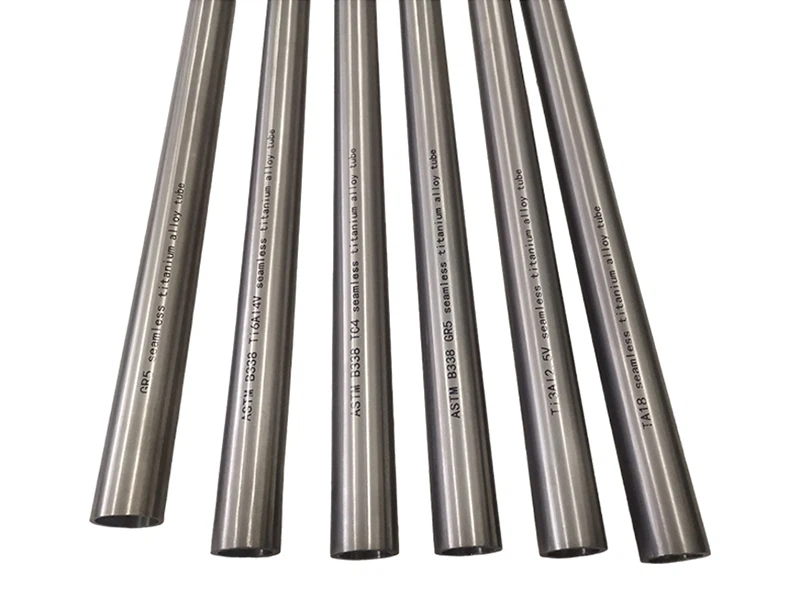
Jurui Metal Technology company is committed to the development and production of high-strength titanium alloy tubes in China. After 5 years of research and development, we have successfully overcome the difficulties of TC4(Gr5) Ti6Al4V titanium alloy tube processing, as one of the few manufacturers in the world, it has become one of the leading suppliers of TC4(Gr5) Ti6Al4V titanium alloy tubes in China and one of the top manufacturers of titanium alloy tubes.

Why choose us
Product Grades
We offer several grades of titanium alloy tubes, including TC4 (GR5 TI6Al4V), TA18 (Gr9), TA16 (Ti2.5Al2Zr), and TC11 (Ti6.5Al1.5Zr).
Production Equipment
Our production facility is equipped with an extruder, pipe rolling machine, annealing furnace, straightening machine, tube shrinking machine, drawing machine, and eddy current testing equipment.
Production Market
We serve markets in Australia, Russia, the USA, Germany, Japan, and South Korea.
Good Service
We provide high-quality after-sales service, including usage tracking and encouraging positive feedback. Our team responds rapidly within 24 hours.
Our Company
Jurui Metal Technology Co., Ltd. is located in Jiangyin, a water town in the south of the Yangtze River. As a global supplier of polyurethane wheels, polyurethane rollers, and other polyurethane products, Jurui Metal Technology is committed to creating added value for customers worldwide.
What is Aircraft Aluminum Tubing?
Aircraft Aluminum Tubing refers to tubular products made from aluminum alloys that are specifically designed and used in the aviation and aerospace industries. These tubes serve a wide range of functions, from structural elements to hydraulic systems.

6061 T6 Tube is a high-quality aluminum alloy tube that is extensively used in various industrial applications. This tube is manufactured from 6061 aluminum alloy which is an excellent material for manufacturing high-quality and durable products.

Aluminum alloys have become essential in various manufacturing processes due to their lightweight, corrosion resistance, and strength. One of the popular aluminum alloys is the 2xxx series, which has copper as its primary alloying element.

Welcome to our company, a leading manufacturer of Aluminum Alloys 5xxx Tube in China, with over 10 years of experience in producing and exporting high-quality products to merchants worldwide.

Aluminum Alloys 6xxx Tube is an essential product for various industries globally. The product has been widely used across several production industries due to its durability, high strength, and lightweight.

Aluminum Alloys 7xxx Tube is an essential product in various industries, including aerospace, automotive, and military sectors. The product is made using aluminum alloy 7xxx that consists of zinc as the primary alloying element.

As a leading manufacturer of high-quality aluminum alloy tubes in China, we are pleased to introduce our product to international merchants. Aluminum alloy tubes are widely used in various sectors, including building construction, automotive, aerospace, and marine industries.
We believe that an excellent team is the core driver of the aggregation and amplification effect of the enterprise, and it is the solid support for the company to become stronger, better and bigger.

One of the key features of the 7075 Aluminum Tube is its high strength-to-weight ratio. This tube is made from 7075 aluminum alloy, which is known for its exceptional strength and durability.

Our 6061 T6 Aluminum Tube is made from 6061 aerospace grade aluminum alloy, which is highly durable and resistant to wear, corrosion, and heat.
Advantages of Aircraft Aluminum Tubing
1. Strength and Durability
Aircraft aluminum tubing possess a number of beneficial properties that make them ideal for aircraft body construction. For starters, they are extremely strong yet lightweight, making them perfect for use in high-performance aircraft which need to be able to fly long distances without compromising on performance. Furthermore, aircraft aluminum tubing have great fatigue resistance and can withstand high levels of stress without breaking down or cracking. This makes them perfect for constructing the fuselage and wings of an aircraft body.
2. Corrosion Resistance
Another key benefit offered by aircraft aluminum tubing is their corrosion resistance. This is especially important when it comes to aircraft since they often spend a lot of time exposed to harsh weather conditions such as rain, snow, wind, and even lightning strikes. Aircraft aluminum tubing offer excellent protection against these elements, ensuring that your plane stays safe and secure during flight.
3. Cost-Effectiveness
Finally, aluminium alloy is also cost-effective compared to other metals, such as steel or titanium, which would require more energy and resources to produce an equivalent amount of material. By using aluminium alloy, you can save money while still getting the same level of strength and durability as other metals. Additionally, manufacturing with aluminium alloy requires less labour than some other metals, which helps reduce costs even further.
Application of Aircraft Aluminum Tubing
Aircraft aluminum tubing are widely used in the aerospace industry due to their high strength-to-weight ratio, corrosion resistance, and ability to withstand high temperatures. These tubes are typically made from 2024 or 7075 aluminum alloy, which are commonly used for structural and decorative applications.
One of the main applications of aircraft aluminum tubing in the aerospace industry is in the fabrication of aircraft frames and structural components. These components are essential for providing the necessary support and stability for the aircraft, and aircraft aluminum tubing are preferred for these applications due to their high strength and lightweight properties.
Aircraft aluminum tubing are also used in the fabrication of wing structures and control surfaces. These components are essential for providing lift and controlling the direction of the aircraft. aircraft aluminum tubing are preferred for these applications due to their ability to withstand high stresses and loads.
Aircraft aluminum tubing are used for fuel lines and hydraulic systems. These components are essential for providing the necessary fuel and fluid to power the aircraft's engines and control systems. aircraft aluminum tubing are preferred for these applications due to their corrosion resistance and ability to withstand high pressures.
Another application of aircraft aluminum tubing in the aerospace industry is in the fabrication of heat exchangers and cooling systems. These components are essential for maintaining the temperature of the aircraft's engine and other critical components, and aircraft aluminum tubing are preferred for these applications due to their high thermal conductivity and corrosion resistance.
Furthermore, aircraft aluminum tubing are used in the fabrication of satellite and spacecraft components. These components must be able to withstand extreme temperatures, pressures, and vibrations during launch and while in orbit. aircraft aluminum tubing are preferred for these applications due to their ability to withstand these harsh conditions and maintain their structural integrity.
The use of aircraft aluminum tubing in the aerospace industry is essential for creating strong, lightweight, and durable aircraft and spacecraft. Their versatility and ability to withstand high stresses and temperatures make them an ideal choice for a wide range of applications, from structural components and control surfaces to fuel lines and heat exchangers.
Aircraft Aluminum Tubing Grades for Aerospace Applications


1. Alloy 2014
A beneficial alloy choice for framework due to its strength and machinability. However, it does not provide the level of corrosion resistance other aircraft aluminum tubing grades do. Therefore, it should not be used in environments with high corrosive environments or environmental stressors.
2. Alloy 2024
2024 aircraft aluminum tubing alloy is used extensively for aerospace and aircraft components. It possesses high tensile strength, is treatable, and stress resistant. It can also be heat treated. aircraft aluminum tubing 2024 plate and sheet are ideal for aerospace applications involving structures, aircraft wings, and repairs.
3. Alloy 3003
This alloy possesses good weldability and corrosion resistance. It is not heat treatable but is one of the more common aircraft aluminum tubing alloys used for aircraft and aviation applications.
4. Alloy 5052
As another aircraft aluminum tubing alloy not suitable for heat treatment, 5052 does have a high fatigue strength compared to other aircraft aluminum tubing alloys. It possesses good formability and corrosion resistance properties and is used commonly for fuel tanks in aircraft.
5. Alloy 6061
6061 aircraft aluminum tubing alloy may be welded and brazed. It is a workable alloy with superb corrosion resistance. It is commonly used in the fuselage and wings.
6. Alloy 6063
This alloy is an excellent choice for architectural structures and anodizing requirements. High corrosion resistance and high tensile properties are some of the features of this alloy. It is an alloy often used for aesthetic purposes.
7. Alloy 7050
7050 aircraft aluminum tubing alloy is a great option for military aircraft and wing skins. This alloy may be reheated and is applicable for military aircraft and wing skins. It possesses a superb strength-to-weight ratio.
8. Alloy 7068
Used extensively for aircraft applications, this alloy is one of the strongest available aircraft aluminum tubing alloys for aerospace applications. It is a popular alloy grade for applications that involve exposure to high level environmental stressors. It possesses a high level of strength and corrosion resistance.
9. Alloy 7075
Aircraft aluminum tubing alloy 7075 has average corrosion resistance and high fatigue resistance. It compares to the strength of steel due to the high level of zinc in its composition. It is ideal for highly stressed parts such as fuselages.
Choosing the right aircraft aluminum tubing for your project is critical to ensuring its success. With so many options available, it can be challenging to know which type of tube to select. In this article, we will provide some guidance on how to choose the right aircraft aluminum tubing for your project.
The first factor to consider when selecting an aircraft aluminum tubing is the intended application. aircraft aluminum tubings come in various grades, each with specific properties and characteristics that make them suitable for different applications. For example, 6061-T6 aluminum is a popular grade for structural applications due to its high strength and excellent corrosion resistance, while 3003 aluminum is commonly used in food and beverage applications due to its excellent formability and weldability.
The second factor to consider is the size and thickness of the aircraft aluminum tubing. The size and thickness of the tube will depend on the specific application and the amount of weight it needs to support. For example, a larger diameter tube will be required for applications that require greater strength and support, while a thinner tube may be suitable for applications that require less weight-bearing capacity.
The third factor to consider is the surface finish of the aircraft aluminum tubing. Different surface finishes can affect the performance and appearance of the tube, so it's important to choose the right finish for your specific application. Anodized aluminum, for example, offers enhanced corrosion resistance and a decorative finish, while a mill finish may be more suitable for applications that require a more industrial appearance.
Finally, it's essential to consider the cost of the aircraft aluminum tubing. The cost of the tube will depend on various factors, including the grade, size, thickness, and surface finish. It's important to balance the cost of the tube with its intended application to ensure that you're getting the best value for your investment.
How to Manufacturing Aircraft Aluminum Tubing?
1. Raw Material Selection
The process begins with the careful selection of high-quality aluminium lloys. The choice of alloy depends on the specific requirements of the final product. Common alloys include 6061 and 6063, known for their excellent strength-to-weight ratio and corrosion resistance.
2. Billeting
The selected aluminum alloy is then heated and cast into cylindrical billets. These billets serve as the starting point for the tube manufacturing process. Temperature control during this stage is critical to ensuring uniformity and eliminating any potential defects in the material.
3. Extrusion
The extrusion process is a key step in transforming the billet into a seamless tube. The heated billet is pushed through a precision-designed die, creating a tube with the desired outer diameter and thickness. This process is highly efficient and allows for the production of long lengths of seamless tubing.
4. Heat Treatment
To enhance the mechanical properties of the tube, it undergoes a heat treatment process. This involves controlled heating and cooling to optimise the material's strength, hardness, and durability. Heat treatment also contributes to stress relief, minimising any internal stresses introduced during extrusion.
5. Cold Drawing
Following heat treatment, the tube is subjected to cold drawing. This process involves reducing the tube's diameter and wall thickness while increasing its length. Cold drawing imparts dimensional precision and improves the surface finish of the tube. It also enhances the tube's mechanical properties and tightens its tolerances.
6. Cutting and straightening
The drawn tube is then cut into specific lengths, and any distortions or deformities are corrected through a straightening process. Precision cutting ensures that the tubes meet the required specifications and standards.
7. Surface Finishing
Aircraft aluminum tubing typically undergo surface finishing processes to enhance their appearance and protect against corrosion. Common surface treatments include anodizing, powder coating, or polishing, depending on the intended application.
8. Quality Control
Throughout the manufacturing process, rigorous quality control measures are implemented to ensure that the aircraft aluminum tubing meet industry standards. This includes dimensional checks, non-destructive testing, and inspection for any surface defects.
How to Store Aircraft Aluminum Tubing
1. Choose a clean and well-drained place
Your warehouse should be clean and well-drained. Also, the storage space should be away from the manufacturing unit that can host harmful gases or dust. Warehouse units can also develop unwanted weeds or sundries, remove them in order to prevent corrosion.
2. Check thoroughly while stacking
There are many materials that are corrosive to steel and should be avoided anywhere around the aircraft aluminum tubing. The steel aircraft aluminum tubing should not be stacked anywhere near to substances such as cement, bases, salt, and acids. In addition to preventing corrosion, this will also help you maintain an organized warehouse.
3. Special storage for different types of aircraft aluminum tubing
Every type of aircraft aluminum tubing should have a separate stacking and storage unit as different pipes can have a different alloy which may or may not be suitable for each other. Also, different types of aircraft aluminum tubing need to have their unique space and should not be stacked together.
4. Selection of a warehouse
The geographical location of a warehouse is very important. If you are using an ordinary warehouse then you are putting your aircraft aluminum tubing into trouble. For storing aircraft aluminum tubing, you need to have a place with roofed walls, tight windows and doors with proper breathing space, even after stacking.
5. Proper Ventilation
A warehouse should not be dingy as the pipes require a clean space with proper ventilation. Despite these unique requirements towards storing the aircraft aluminum tubing, these are amongst the most preferred pipes in multiple industries. We have mentioned a few reasons why the companies are ready to meet these unique requirements and choose aircraft aluminum tubing for their manufacturing unit.
Precautions When Cutting Aircraft Aluminum Tubing
● Wear protective gear: Metal shavings and sparks are generated during cutting, wear goggles, earplugs, and appropriate work gloves to protect yourself.
● Securely fixed: Before cutting, make sure the aluminum tube is firmly fixed on the workbench to prevent it from slipping or wobbling.
● Measuring and Marking: Use a ruler and marking tool to take accurate measurements and marks on the aluminum tubing to ensure proper cut placement.
● Select the appropriate cutting tool: According to the diameter and wall thickness of the aluminum tube, select the appropriate cutting tool to obtain the best cutting effect.
● Slow and Steady Cut: Don't rush the cut, maintain a steady force and speed to avoid jamming the cutting blade or creating an uneven cut.
Our Certifications
GJB9001C-2017


Ultimate FAQ Guide to Aircraft Aluminum Tubing
Hot Tags: aircraft aluminum tubing, China aircraft aluminum tubing manufacturers, aluminum alloy tube for irrigation, aluminum alloy tube for greenhouse, precision aluminum alloy tube, aluminum alloy tube for residential use, alloy aluminum piping, aluminum alloy tube for ventilation system