

The elastic modulus, also known as Young's modulus, is a fundamental mechanical property that describes the stiffness of a material. It represents the ratio of stress to strain within the elastic deformation range of a material. In simpler terms, it measures how much a material will stretch or compress under a given load before it reaches its plastic deformation state. For those involved in industries such as aerospace, medical, and chemical processing, understanding the elastic modulus of materials like GR5 seamless titanium alloy tubes is crucial for designing safe and efficient components.
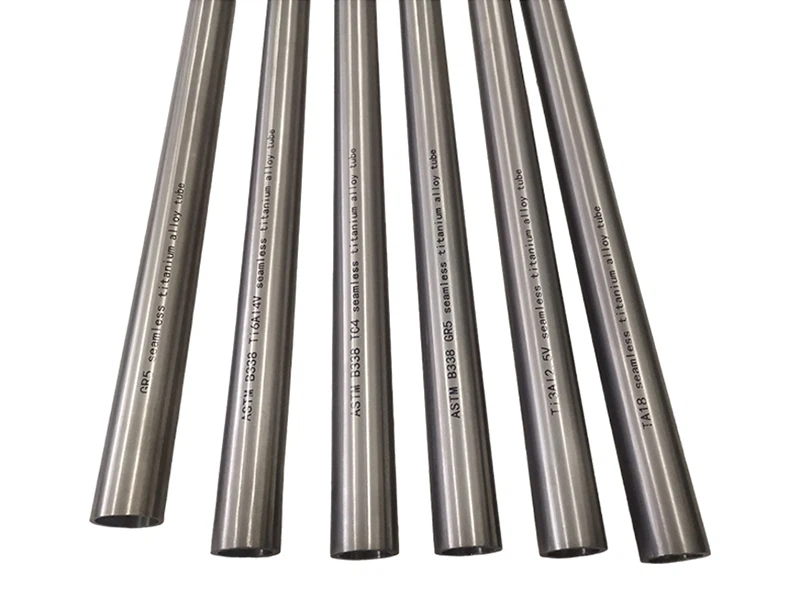
GR5 titanium alloy, also known as Ti-6Al-4V, is one of the most widely used titanium alloys due to its excellent combination of high strength, good corrosion resistance, and low density. As a supplier of GR5 seamless titanium alloy tubes, I have witnessed firsthand the growing demand for these tubes in various high - performance applications.
The elastic modulus of GR5 seamless titanium alloy tube typically falls within the range of 110 - 120 GPa (gigapascals). This value can vary slightly depending on several factors, including the manufacturing process, heat treatment, and the specific chemical composition of the alloy.
Manufacturing Process
The manufacturing process of GR5 seamless titanium alloy tubes can have a significant impact on their elastic modulus. For instance, the extrusion process is commonly used to produce seamless tubes. During extrusion, the titanium alloy billet is forced through a die to form a tube. The high - pressure and high - temperature conditions during extrusion can affect the grain structure of the alloy. A fine - grained structure generally leads to a more consistent elastic modulus. On the other hand, if the extrusion process is not well - controlled, it may result in inhomogeneous grain growth, which can cause variations in the elastic modulus across the tube.
Another manufacturing method is the cold - drawing process. Cold - drawing involves pulling the tube through a series of dies at room temperature to reduce its diameter and increase its length. This process can introduce residual stresses in the tube, which may also influence the elastic modulus. However, proper annealing after cold - drawing can relieve these residual stresses and help to achieve a more stable elastic modulus.
Heat Treatment
Heat treatment is an important step in the production of GR5 seamless titanium alloy tubes. Different heat treatment processes, such as annealing, solution treatment, and aging, can alter the microstructure of the alloy and thus affect its mechanical properties, including the elastic modulus.
Annealing is a process of heating the tube to a specific temperature and then slowly cooling it. This helps to relieve internal stresses, refine the grain structure, and improve the ductility of the alloy. A well - annealed GR5 seamless titanium alloy tube usually has a more predictable elastic modulus.
Solution treatment involves heating the alloy to a high temperature to dissolve the alloying elements uniformly in the titanium matrix. Subsequent quenching and aging can then precipitate fine particles in the matrix, which can enhance the strength of the alloy. However, these microstructural changes can also have a minor effect on the elastic modulus.
Chemical Composition
The chemical composition of GR5 titanium alloy is defined by the amounts of aluminum (Al), vanadium (V), and other trace elements. The nominal composition of Ti - 6Al - 4V is 6% aluminum, 4% vanadium, and the rest is titanium. Small variations in the content of these elements can affect the elastic modulus. For example, an increase in the aluminum content can generally increase the strength and stiffness of the alloy, which may lead to a slightly higher elastic modulus. However, excessive aluminum content can also make the alloy more brittle.
Importance in Applications
The elastic modulus of GR5 seamless titanium alloy tubes is of great importance in various applications. In the aerospace industry, these tubes are used in aircraft structures, such as wing spars and fuselage frames. The high elastic modulus of GR5 alloy ensures that the tubes can withstand the high stresses and loads experienced during flight without excessive deformation. This is crucial for maintaining the structural integrity and safety of the aircraft.
In the medical field, GR5 seamless titanium alloy tubes are used in orthopedic implants, such as bone plates and screws. The elastic modulus of the alloy should be close to that of human bone to avoid stress shielding, which can lead to bone resorption. The relatively low elastic modulus of GR5 alloy compared to some other metals makes it a suitable material for medical implants.
In the chemical processing industry, GR5 seamless titanium alloy tubes are used in heat exchangers and pipelines due to their excellent corrosion resistance. The elastic modulus of the tubes is important for ensuring that they can withstand the pressure and temperature variations in chemical processes without failure.
Comparison with Other Titanium Alloys
When compared with other titanium alloys, such as Gr9 Seamless Titanium Alloy Tube, GR5 has a relatively higher elastic modulus. Gr9 titanium alloy, also known as Ti - 3Al - 2.5V, has an elastic modulus in the range of 100 - 110 GPa. The higher aluminum and vanadium content in GR5 contributes to its higher stiffness.
Quality Control
As a supplier of GR5 Seamless Titanium Alloy Tube, we implement strict quality control measures to ensure that the elastic modulus of our tubes meets the required standards. We use advanced testing equipment, such as ultrasonic testing and tensile testing, to measure the elastic modulus of the tubes. Ultrasonic testing is a non - destructive testing method that can quickly and accurately measure the elastic modulus by analyzing the propagation of ultrasonic waves in the material. Tensile testing, on the other hand, involves applying a gradually increasing load to a specimen until it breaks, and measuring the stress and strain during the process to calculate the elastic modulus.
Conclusion
In conclusion, the elastic modulus of GR5 seamless titanium alloy tubes is an important mechanical property that is influenced by the manufacturing process, heat treatment, and chemical composition. Understanding the factors that affect the elastic modulus is crucial for ensuring the quality and performance of the tubes in various applications. As a reliable supplier of GR5 seamless titanium alloy tubes, we are committed to providing high - quality products that meet the specific requirements of our customers. If you are interested in our ASTM B338 Ti6Al4V Seamless Titanium Alloy Tube or have any questions about the elastic modulus or other properties of our products, please feel free to contact us for further discussion and potential procurement.

References
- ASM Handbook Volume 2: Properties and Selection: Nonferrous Alloys and Special - Purpose Materials.
- Titanium: A Technical Guide, Second Edition by John C. Williams.
- ASTM B338 Standard Specification for Seamless and Welded Titanium and Titanium - Alloy Tubes for Condensers and Heat Exchangers.